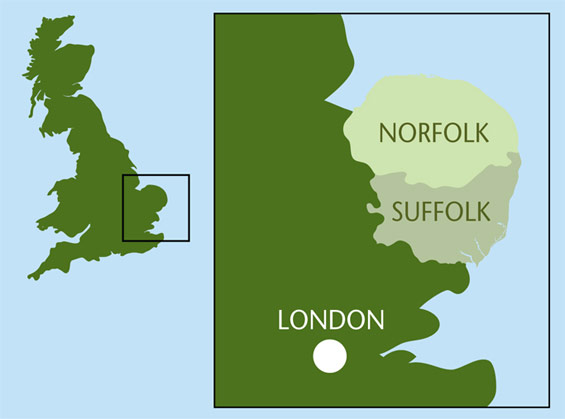
There’s something rather special about Suffolk.
You’ll find it by the creeks and coastline, in the medieval timbers of pink-washed cottages, or perhaps simply all around you in the warm Suffolk light, refreshing air and enormous wrap-around skies.
We can’t pinpoint which bit you’ll find the most appealing, but we’ve tried to give a little background to a few of our favourite places included in our walking tours.
Find out more about our Suffolk walking breaks
See the fishermen hauling up their boats onto the shingle beach at this fine old-fashioned seaside town. A great place to eat fresh fish and chips, watch the model yachts on the boating pond or stroll along the High Street with its interesting shops. Home to the now (in)famous Maggi Hambling scallop sculpture inspired by the work of composer Benjamin Britten. The town has given its name to the famous music festival - if you wish to attend a concert we will be happy to send you details in advance.
Sitting within the Suffolk Coasts and Heaths 'Area of Outstanding Natural Beauty' - Bawdsey is home to a foot ferry service across the mouth of the River Deben to the village of Old Felixstowe. The village is renowned for its late 19th C. Manor House which is where radar research took place early in World War II. Tons of granite from Norway help protect the coast from erosion here.
An ancient market town, full of history and old Suffolk charm. Walk through the massive stone gateway to the ruined abbey, now forming the backdrop to beautiful and award-winning gardens. The magnificent cathedral is noted for its stunning Millennium Tower. Visit on Wednesday or Saturday for the excellent open air market. Other treats include taking in a show at the historic Theatre Royal, a guided tour of the Greene King brewery and a pint at The Nutshell - Britain's smallest pub.
A beautiful little village of half-timbered cottages, Georgian facades and rambling rectories. For over 40 years, the village has staged a renowned Open Gardens Weekend which really shows its English country charm at its best. All Saints' Church has an idyllic setting by the River Brett, and the 14th C. Peacock Inn sits opposite the village's delightful bridge.
The road through this small settlement ends dramatically at the crumbling cliffs which sweep down the coast to the seaside town of Southwold. A short distance inland are the melancholic ruins of the enormous medieval church, which was deemed to large in the 17th C. and was replaced with the smaller thatched building built within the shell - a 'church within a church'.
The village of Darsham is situated just off the main A12 road between Ipswich and Lowestoft. It is home to a little railway station which offers excellent access (by taxi) to the nearby coastal village of Dunwich and the famous RSPB Minsmere Nature Reserve. The flint All Saints' Church has elements dating back to the 12th C.
A former court of East Anglian Kings, this attractive large village is set near the source of the River Deben. Once a thriving wool centre, Debenham has overhanging timber-framed houses and antique shops. It is also home to a world famous teapot pottery where visitors can watch them being made and painted by hand, then sample delicious homemade cakes in the tearoom.
Set by the River Stour, this picturesque village is set in the heart of Constable Country. It was here that Britain's greatest landscape artist went to school, walking across the meadow path between Dedham and his father's former mill at Flatford.
The main street is home to Georgian-fronted houses, old inns and a large art/craft centre. The magnificent 15th C. church was built from the wealth of the medieval wool industry and houses a Constable altar piece. Rowing boats can be hired on the river.
A haunting place where the village all but lies lost beneath the waves. In the days of King John, this was the capital of East Anglia - a gated, ramparted town with at least eight churches. Visit the award-winning Dunwich Museum to learn how the village has disappeared over the years. Ruins still cling to the clifftop. No wonder, author P.D. James found this a fascinating place to gather up inspiration. Nearby is the wild landscapes of Dunwich Heath, with its colourful heather and gorse.
The birthplace of John Constable - Britain's greatest landscape artist. A plaque on some railings marks the location. Whilst a nearby cottage was used as a former studio. Visit the church - resting place of Constable's parents, alongside a 16th C. bell cage on the ground next to the unfinished tower. The Devil is said to have cast down the tower at night as quickly as the builders could build it by day! This bell cage is one of the area's finest and perhaps quirkiest medieval edifices.
Felixstowe is an Edwardian resort, retaining much of its original charm, with beautiful south-facing gardens, paved promenade and Spa Pavilion. It's popularity began with the railway in 1887. These days, it also has its fair share of modern day seaside razzmatazz along the prom and pier. Felixstowe is home to the UK's largest container port, situated to the south of the town beside the Landguard Peninsula, with its historic fort, museum, nature reserve and view point.
This little hamlet to the north of the town of Felixstowe is home to a foot ferry service across the mouth of the River Deben to the village of Bawdsey. There is a church and a handful of fishermen's cottages, alongside a couple of pubs, the Ferry Cafe, a boatyard and local sailing club. A walk alongside the water will take you past two historic Martello towers.
Just down the hill from East Bergholt, Flatford Mill was once owned by the artist John Constable's father. A guided tour is a great way to be introduced to some of the local scenes depicted in Constable's paintings such as "The Haywain". Alternatively, why not rest up your feet and let your arms take to the oars - with rowing boats available for hire. What better than to experience the gentleness of the sedate River Stour - earning yourself a delicious afternoon treat in the riverside tearoom.
A quiet and very authentic market town with many interesting buildings. St. Michael's Church contains impressive historic tombs and effigies. The superb 12th C. castle was built by the Earls of Norfolk. The very well preserved curtain wall has thirteen integral towers - the design was considered revolutionary in its day. This was the home to Mary Tudor in 1553 when she learnt of her accession, and the castle owes its twisted redbrick chimneys to the splendour of the Tudor period.
This busy market town in the Brett Valley was once a Viking royal settlement. Through the wool trade, it rose to become one of the most prosperous towns in the country in the 14th and 15th C. The medieval heart of Hadleigh is still very much in evidence, with many fine old buildings to be seen on the High Street, some displaying examples of pargetting. The magnificent church
with its towering spire overlooks the churchyard with its
timber-framed Guildhall and red brick Deanery.
Despite being a remote location, the village of Iken historically had many trading routes. As well as being an important fishing centre, sailing barges used to transport corn from Iken Cliffs to London in the 19th C. These days, it's lost and sleepy, but for many their favourite hidden place in Suffolk. The thatched
St. Botolph's sits close up to the river. There has been a church on this site for almost 1350 years and it is an ancient place of pilgrimage. Inside is the remains of a Saxon cross.
One of England's oldest towns, dating back to Saxon times, though it is known more today for its busy shopping centre and University Campus. It's streets are lined with historic buildings such as 12 medieval churches, alongside the Ancient House which has amazing pargetting. Sitting in parkland, the red brick Christchurch Mansion houses a fascinating free museum home to some of John Constable's paintings. The town also has a rich maritime heritage, with a interesting waterfront and marina area.
If you think Suffolk is flat - think again! This is most probably one of England's prettiest villages. Half-timbered houses sweep down to the water splash where ducks seem to have right of way over everything which passes. The church stands high above the village like some proud grandfather. This is where Father Time has sat down to put his feet up. We suggest you do the same!
Not to be missed! This is simply the most spectacular of the Suffolk Wool Towns - wonderfully atmospheric, with a unique collection of medieval buildings. If you can tear yourself away from the maze of streets and lanes lined with half-timbered gems, or the amazing Guildhall of Corpus Christi onthe Market Square, head uphill to the enormous medieval flint church with is massive tower. Lavenham offers a huge variety of shops, galleries, pubs and restaurants to enjoy.
As the name suggests, this picturesque village is set along a broad attractive street over a mile in length. At the northern end is the magnificent church and two splendid Tudor red brick mansions - the privately owned Kentwell Hall famed for its re-creations of Tudor life; and Melford Hall, now in the safe-keeping of The National Trust, which has links with author Beatrix Potter. Both properties are open to the public.
This town is set at the head of the Stour Estuary, its waterfront popular with sailing boats. There are many fine Georgian buildings at this historic old smugglers haven, which also boasts connections with the infamous Witchfinder General (Matthew Hopkins). The railway station (with its renowned buffet and pub) is set on the Essex/Suffolk border, with a direct footpath out into Constable Country - via water-meadows to Flatford Mill.
This renowned RSPB reserve set on the lovely Suffolk Coast features 2,000 acres of marsh, lagoon, reed-bed, heath and woodland. The variety of birdlife here is immense, including wonderful Marsh Harriers, hallmark Avocets and the booming Bittern. Even if you're not a regular twitcher, you really have to take a look on one of the numerous trails.
Now a small village, this was once a prosperous port in Elizabethan times. It is now inaccessible to all but pleasure craft due to the growth of the mysterious Orfordness, a shingle spit some ten miles long - now owned by The National Trust. With the commercial lifeline cut off, the old world character of this charming coastal retreat has been preserved. The impressive 12th C. castle offers good views over the river.
This small coastal settlement is set at a quiet and beautiful spot beside the tip of Orfordness.
Snape Maltings is set at a lovely riverside setting, and features a famous concert hall - home of the Aldeburgh Festival started by composer Benjamin Britten. Take time to explore the art galleries and craft shops, then relax in the pub and tea room. Tide permitting, you can also take a boat excursion around the upper reaches of the River Alde - a good way to see the animal and bird life of the neighbouring salt marshes.
A pretty hilltop village of jettied houses and oak-beamed pubs. The church tower, standing on the highest ground is some 120 feet high. It can be seen for miles around, and was often featured in paintings by the landscape artist John Constable.
Bustling market town set in the Gipping Valley. Its medieval heart lay around the parish church with its impressive modern spire. Step into the Museum of East Anglian Life at the top of the town with its reconstructed hall house, smithy, water and smock mills. There are also wildlife walks down beside the river.
Ancient market town built on a defensible loop of the River Stour, bordering Essex. The famous artist Thomas Gainsborough was born here in 1727 - his house now preserved as a museum and art gallery. His statue stands proudly on the Market Square.
A distinguished seaside town with a definite old world charm. Elegant rows of pantiled Georgian cottages stand between broad greens on a cliff top above the North Sea. The lighthouse overlooks the prom which is lined with colourful beach-huts. The pier is a jolly place with some interesting artistic offerings and a tasteful restaurant too. Don't forget, this is the home of Suffolk brewer Adnams, and these days, if their traditional ales are not your cup of tea, you can enjoy an Earl Grey perched in the old brewhouse coppers in their smart cafe and cellar shop.
Located across the River Deben from Woodbridge, this is the site of the richest burial ever discovered in Britain - an Anglo-Saxon ship containing magnificent treasures. It is thought to be the grave of Raedwald, one of the earliest known English Kings, who died c624AD. Piece together the story for yourself at the excellent exhibition, then take a walk out to the burial mounds. There are woodland walks too and some stunning views across to the town of Woodbridge. The property is in the safe-keeping of The National Trust and guided tours are available.
A rather eccentric, but totally charming place just up the coast from Aldeburgh. Thorpeness is an Edwardian holiday village created from 1910 by Stuart Oglivie, and designed to provide self-catering holidays to families. The village consists of weather-boarded fishermen's cottages, a freshwater boating lake (The Meare), a post-mill and the converted water-tower known as the 'House in the Clouds'.
Located in the area known as 'The Sandlings' , there are three separate forest areas, known as Dunwich, Rendlesham and Tunstall. They consists of coniferous plantations, broadleaved belts and heathland - a haven for ground nesting birds such as the Nightjar and Woodlark.
Built on the banks of the River Deben, this attractive market town has a history of ship building and sail making. The famous Tide Mill has been restored to full working order and is open to the public. The historic narrow streets have a varied array of interesting shops. Head up to the Market Square to find the Shire Hall and the impressive St. Mary's Church, as well as some smart and quirky little shops and historic pubs.